Leveraging social networking to influence change
PR Blogger Stephen Davies thinks we’ll start to see a fragmentation of social networks. As people begin to tire with the vast, general nature of MySpace et al, they may migrate to niche social networks that are more relevant to them, their passions and their lives.
He asks:
So what does it mean for brands? Niche social networks can be tapped into for more relevancy in online engagement. For example, which platform makes the most sense for a brand like Pedigree? Bebo or DoggySnaps?
Stephen continues…
But identifying the right platform is just the minor part. It’s how you engage with the users in a creative, respectful and non-intrusive manner which will be the key to a successful online PR campaign…
Spot on, Stephen. I’ll come back to that.
Interestingly, there is already some activity in the ’social networks for change’ space. Change.org launched last month, and Cauzoo.com will be “a space where you can promote your passion, rally for a cause, and raise money for charities in a variety of different ways.”
And then there’s Carebadges… who do it with widgets.
It’s early days, but I’m not totally convinced that these social networks are themselves authentic enough: they seem a little forced… activism for activism’s sake (not that there’s anything wrong with that particularly). I’m not sure about the lack of focus though - well, unless you’re an activist first, and something else second.
You need to get close to where your supporters are (and their distributed network)… which is why DoggySnaps is so good.
Moving on… I’ve harped on before about how I registered the mycauses.org.uk domain and how I hoped one of the players in the social networking space would create a “My Causes†tab in their members’ profile pages.
Well, I’m pleased to see that LinkedIn has moved a step in this direction, and should be applauded - thanks to Kerri Karvetski for the tip-off.
LinkedIn for Good
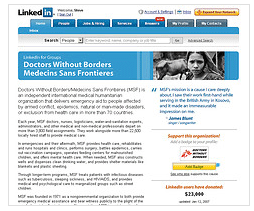
The first not-for-profit to benefit from a presence on LinkedIn is Médecins Sans Frontières.
It looks pretty good… up to a point! I feel it’s only a start though, as this still has the feel of what you might call a “networked giving” and nothing more - in other words, too much focus on fundraising.
The implementation on a member’s profile page (see below) could be improved. I’m not sure that “Member” is entirely accurate in this context either.
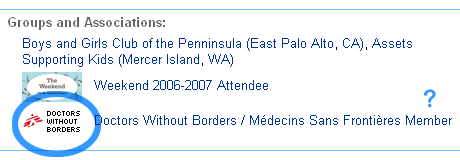
What if I want a different kind of relationship with a not-for-profit… or with a cause with which I identify for some reason?
LinkedIn members are - on the whole - accustomed to having more of a voice. In fact, I believe that LinkedIn will discover that members will desire a 360 degree relationship with not-for-profits.
LinkedIn feels entrepreneurial. There’s real potential here I think for the not-for-profits to engage members of the LinkedIn network in a relationship that goes beyond giving. Think of members of LinkedIn as potential ambassadors for your cause.
I might be able to indicate in my profile that a preference for becoming a virtual volunteer and trustee.
As Jeff Brooks writes, donors can also give:
- Information: ranging from market insight to specialized professional knowledge.
- Voice: the ability to speak for you in many ways.
- Influence: the ability to help things go your way.
And of course, donations will surely follow.
The 9m+ members of LinkedIn must carry a fair bit of clout between them. You’d think it would be pretty unstoppable if this collective intelligence - already into thinking about network-building and showing leadership in a networked world - could be harnessed to support individual actions through the social network, even to find solutions to problems.
I can actually foresee new agile social enterprises springing up from a network like LinkedIn… united by their ability to connect to others with shared passions, complementary skills, and a vision to change things. And I’m sure there’s a link here with the creation of like the Omidyar Network and Kiva.
There, I’ve just this minute received an email from LinkedIn’s Dave Sanford (thanks for getting back to me, Dave), so this post should serve as a good discussion opener!
Returning to the DoggySnaps example… what started as a photo-sharing community has the potential to evolve into a dynamic social network.
Niche, yes… but it can extend the reach of the Dogs Trust, the not-for-profit behind it.
(Related post: my DoggySnaps interview).
Update: See Dave Sanford’s response, below…
doggysnaps, linkedin, mycauses, net2, niche social networks, nptechuk


March 20th, 2007 at 7:44 pm
I’m not sure if you’d call us a social network, but the existence of the Blackbaud User Society is predicated on making Blackbaud products better, and making non-profits more successful. Blackbaud produces software exclusively marketed towards non-profits, but historically has not listened to their users at all when it came to what we wanted to see their products do.
Our network allows users of Blackbaud products to:
- network with each other (www.blackbus.org/forum)
- exchange tips and tricks to get the best value out of the software we have already purchase
- find recommendations for Blackbaud and other products to help our orgs
- provide a funnel of communication for what we want the products to do (www.blackbus.org/ideas)
We are completely seperate from Blackbaud, charge no fees for membership, and welcome just about everyone.
Our niche is clearly those who already use Blackbaud products. Based on growth over the last year, lots of people think it is the best place to get their information - perhaps even over gettting it direct from Blackbaud.
March 20th, 2007 at 9:32 pm
[...] Read more here: Steve Bridger [...]
March 21st, 2007 at 7:34 am
I was happy to see Kiva.org mentioned in this content. We recently did a 24 hour live http://talkathon.org for Kiva.org to raise awareness.
The use of network facilities and time to connect individuals who are willing to loan to potential borrowers could have, no does have an enormous impact and I’m proud to have become a lender within minutes of visiting http://kiva.org
Thank you for spreading this knowledge in your interesting analysis of social networking.
March 21st, 2007 at 1:44 pm
I think the most interesting issues in this are how such communities will develop in line with organisation’s overall strategies and with how people want to engage in social networks.
I would be surprised if all but the largest organisations (or the most entrepeneurial) have the funds to invest in the time to create a brand presence and effective campaigning/fundraising/marketing strategy with each of these emerging campaigning social networking sites. I think that most organisations will be more eagre to create their own social networking spaces, where people will campaign under their banner. (This will also give organisations more control over brand and message - something that I think most marketers are loathed to lose!). This obviously goes against the grain of social networking - the point is not to get people coming to you, but to diseminate your message.
That got me thinking about the whole idea of campaigning social networking sites. I think it is perhaps a bit misguided to develop a whole campaigning social network. People will very rarely identify themselves purley as campaigners. Surely it is better to integrate campaigning and causes into the social networks that people already operate in. The causes need to be adapted into people’s lives, it needs to be integral, not something that is tacked on top. Widgets obviously do this to some extent, but for it to be truely effective, organisations need to develop ways of bringing inspiring content into these exisiting networks with specific and achieveable calls to action.
March 21st, 2007 at 5:19 pm
Thanks, Steve, for your post! Let me emphasize that what we’ve done IS just a start, and I thought I’d provide some more background on what we’re trying to do with this initiative and its origins:
LinkedIn for Good (a working title) evolved out of conversations some of us were having here at LinkedIn about how we could better leverage LinkedIn’s amazing platform – almost 10 million professionals 50% U.S/50% international, full of influencers and powerful professionals – for social good.
Beyond simply raising funds, we view the ability to add a badge to your profile as a critical part of the program – in addition to raising funds. In fact, we’ve built a viral loop into the profile badge: when someone views the MSF/Doctors Without Borders badge on a profile, for example, clicking on the badge will take them to the page where they can then add the badge.
The reason the badge is where it is (and also the reason people are referred to as “members”) is due to the fact that we’ve re-purposed our LinkedIn for Groups functionality to get this out the door quickly. We’re now working on giving the nonprofit initiative a more formal place within LinkedIn.
I’m working with several other outstanding organizations, so there should be more causes to choose from soon! Funny that you mention Kiva and Omidyar…(suggestions from readers encouraged, btw).
Thanks again both for your feedback and your support!
Dave Sanford
Product and Business Analyst
LinkedIn
http://www.linkedin.com/in/bigsanford
March 21st, 2007 at 7:04 pm
Steve,
Thank you for the link to kk’s blog.
I posted a comment over on my blog about this: I think the Linked In badge program is a great start, but I like the model where you can generate your own badge on the fly, like the other services (as long as it’s an official 501c3. I’m toying with launching something for my daughter’s daycare center, which is a nonprofit. They need money to replace playground equipment, to take field trips and add programming like music.
Not exactly Doctors Without Borders, so I doubt it has the critical mass to make sense for Linked In to offer to it’s members. But it matters a great deal to me and I’ll be leveraging my personal network to support it.
In any case, great to find a new great blog to read.
Cheers,
Kerri Karvetski
http://www.CompanyKMedia.com
“I help nonprofits and businesses communicate online and in person.” -kk
SEE HOW WE’RE CONNECTED
http://www.linkedin.com/in/companykmedia
March 21st, 2007 at 10:25 pm
Andrew, “Surely it is better to integrate campaigning and causes into the social networks that people already operate in.” I agree, although I think DoggySnaps is an interesting exception.
Dave, thanks for connecting and for your ‘response’. Pleased that what we have seen so far is just the beginning. I’m 100 percent behind you.
Kerri - thanks for giving me the initial tip-off about the LinkedIn initiative. Interested in your plans for your daughter’s daycare centre. I’m also a parent governor (as we call them in the UK) at my daughter’s infant school. I’ve created a blog for the school… and am considering a fundraising widget / badge.
Steve
March 22nd, 2007 at 8:30 pm
I work for a company called Firstgiving. Firstgiving is a company that helps anyone create a free personalized fundraising page for any non-profit registered with GuideStar. With Firstgiving idividuals can complement any social network they are on with a social campaign of their choice. All they have to do is create a page and then promote it with a widget, badge, or a short paragraph on social networks that they are ALREADY on (Facebook, MySpace, Bebo). It’s a way individuals to rally their social network for a cause that they are passionate about. It’s a way to mix the typical social networks with a great cause.
April 10th, 2007 at 11:52 pm
steve, I share your doubts about whether ’social networks for change’ will have an authentic buzz.
OTOH, I’ve joined two networks on Ning in the last week. Seems to me that gives non-profits & campaigners a no-overhead way to experiment with niche networking.
So it’ll be interesting to see if any distinctly ‘activist’ type emerges.
dan
May 14th, 2008 at 5:31 am
[...] nfp 2.0 » Leveraging social networking to influence change - “PR Blogger Stephen Davies thinks weâ��ll start to see a fragmentation of social networks. As people begin to tire with the vast, general nature of MySpace et al, they may migrate to niche social networks that are more relevant to them, their passions and [...]